The Credential Is Only the Start
National digital ID is scaling fast across high-growth markets. Here’s what it changes for businesses that make identity decisions, and what it doesn’t.
October has been a busy month for national digital ID, and most of the news has come from markets where economies are growing fastest.
In Ethiopia, the Fayda program had registered 52.4 million people by mid-October and processed roughly 200 million authentication requests. It now handles about two million a day, and it has started charging organizations between five and ten US cents per verification. Registration stays free for citizens.
In South Africa, the Home Affairs minister demonstrated a working version of the MyMzansi digital ID app on October 1. It is designed to hold a citizen’s ID and civil documents on their phone and let them share specific details by QR code, although the full system isn’t expected until after 2030.
Vietnam opened its VNeID app to legally resident foreign nationals, and its revised rules now require organizations to use documents a person already holds in VNeID instead of asking them to produce the same documents again.
Benin, Ghana and Rwanda have connected their national identity systems through Smart Africa’s data exchange to test whether an ID issued in one country can be verified in another, with each country keeping control of its own records. Bangladesh says a single national digital identity is 18 to 24 months away. And this week, The Gambia said it is adopting Ghana’s identity technology.
One at a time, these are local stories. Together they describe something bigger: across a large part of the world, the national ID is becoming digital infrastructure.
Why this is good news
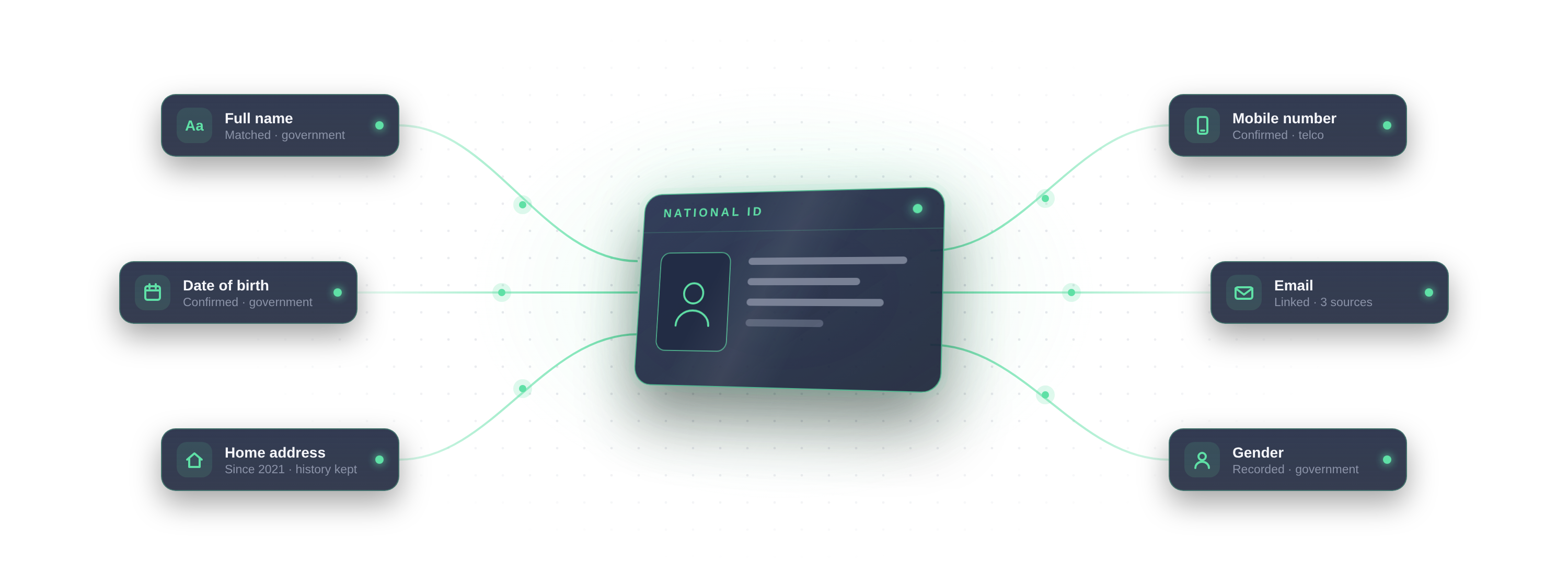
For anyone who makes decisions about people, a stronger national ID is welcome. It gives every identity an authoritative anchor, issued by the state and increasingly reachable through an API rather than a photocopy. In markets where records have long been scattered across national ID, phone, email, date of birth and address data, that anchor is what everything else attaches to.
It is also how we build our own identity graph: every profile anchored to a national ID, using primary-source government and telco data, licensed and resolved in-country.
Three things it changes for businesses
Verification is becoming infrastructure, with a price. Ethiopia’s new fees are small per check, but they make a point every high-volume business will recognize. When every verification has a cost, resolving an identity once and keeping it current is worth more than checking it again at every step.
Reuse is becoming an expectation. Vietnam’s rule that organizations should use documents a person already holds digitally, rather than ask for them again, is a preview of what customers everywhere will come to expect: that a business already knows who they are.
Identity is starting to cross borders. The Smart Africa pilot is early, and no date for live testing has been announced. But the model it is testing, verification across countries while each keeps sovereign control of its own registry, points to where cross-border identity is heading.
What a credential doesn’t tell you
A digital ID answers one question very well: is this person who they say they are, at the moment they present it?
Most business decisions need a little more. Which phone number and email belong to this person, and since when? Which address is current? How has their identity changed over time, and how does it connect to the records and people around it? Those answers don’t live in the credential. They live in the data around it, held by different sources and updated at different times.
That isn’t a gap in national ID programs. It is a different job. The credential confirms the person. Identity intelligence connects everything else to them: resolving scattered records into one persistent profile, with a source, a date and the evidence behind every attribute, and keeping it current as life changes.
The anchor and the network
The countries building digital ID fastest are largely the same ones where digital finance, commerce and public services are growing fastest. As national IDs get stronger, every business serving those markets gets a better anchor. What they build on it, a connected, current and evidenced view of the person, is what turns a verified identity into a decision they can stand behind.
The credential is the start of the identity. It isn’t the whole of it.
See how 1datapipe resolves identity across high-growth markets. Contact us.
SOURCES:
THINK Digital Partners (Oct 5, 2026)
THINK Digital Partners (Oct 26, 2026)
Ghanaian Times (Oct 27, 2026).